Bad Judgement Boogie - Mp3
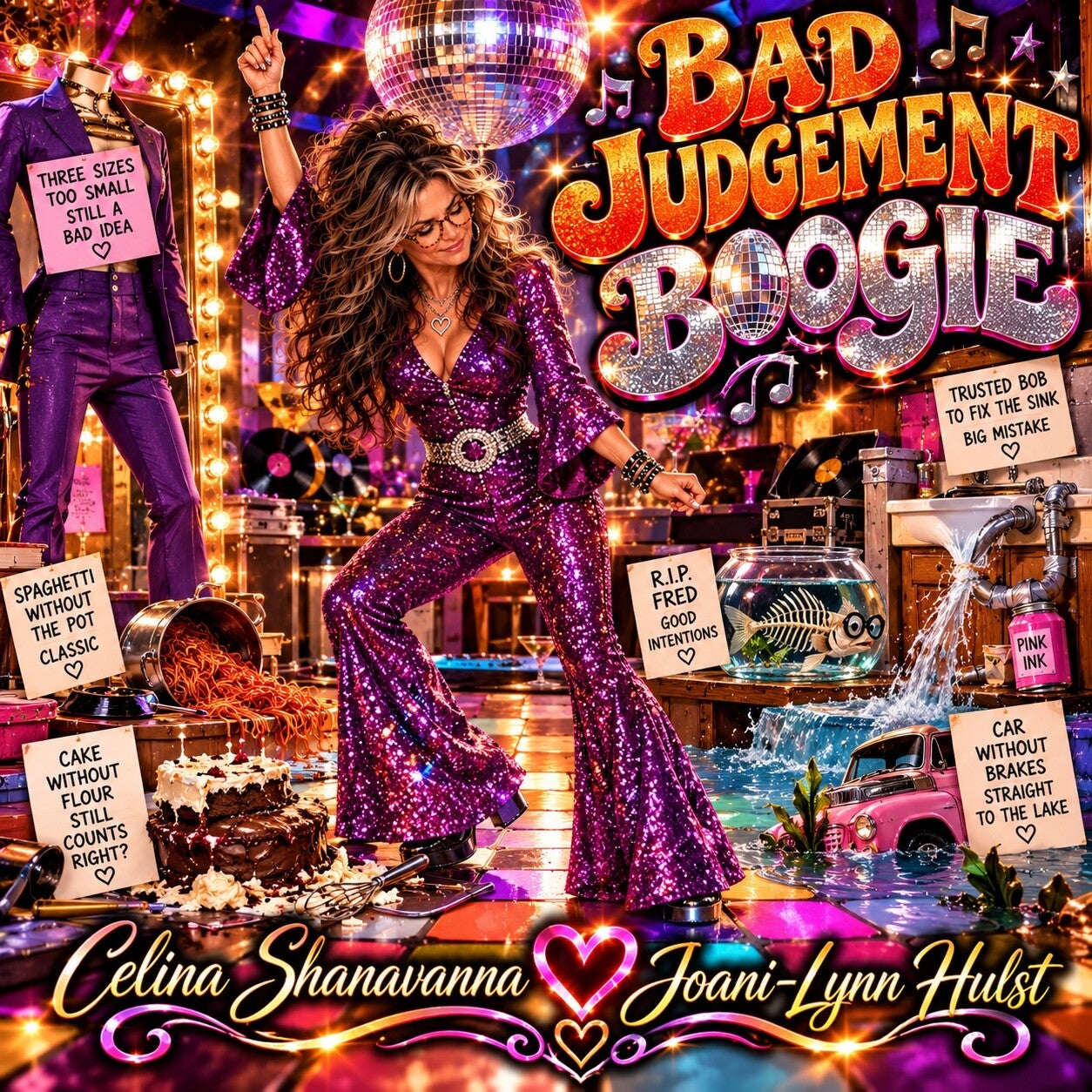
🎵 Listen to full song below
Theme:
Bad Decisions, Learning Through Experience, Trial and Error, Comedic Life Lessons, Poor Judgement, Embarrassing Mistakes, The Price of Experience, Self-Deprecating Humour, Everyday Disasters, Unexpected Consequences, Laughing at Yourself, Wisdom Through Failure, Absurd Situations, Personal Growth, and Finding Humour in Life's Mistakes.
Description: 3:14
Bad Judgement Boogie is a hilarious, playful, sarcastic, and wonderfully chaotic comedy song about the ridiculous mistakes people make while learning one of life's most important lessons: good judgement often develops through experience, and experience frequently comes from bad judgement.
The song transforms this familiar piece of wisdom into a series of increasingly outrageous situations.
The narrator is someone who repeatedly makes questionable decisions, suffers the consequences, and somehow manages to find humour in every disaster.
From buying a suit three sizes too small to attempting an impressive dance move that ends in painful embarrassment, the narrator establishes themselves as a walking example of what happens when enthusiasm gets ahead of common sense.
But the mistakes do not stop there.
The narrator attempts to cook spaghetti without a pot.
Bakes a cake without flour.
Purchases a fish that is already dead.
Buys a car without brakes.
And trusts someone named Bob to repair a sink, only to discover that Bob's plumbing abilities are apparently as questionable as the narrator's decision-making.
Each situation becomes more ridiculous than the last.
The humour comes from the narrator's extraordinary ability to turn simple activities into complete disasters.
However, beneath the exaggerated comedy is a recognizable observation about human nature.
People do not always learn from being told what to do.
Sometimes they insist on discovering things for themselves.
And occasionally, those discoveries are embarrassing, expensive, inconvenient, or downright ridiculous.
The narrator repeatedly acknowledges that their decisions have consequences.
Yet instead of becoming bitter or defeated, they transform their failures into entertaining stories.
The song also uses an interesting contrast between confidence and competence.
The narrator frequently believes they are making clever decisions.
Only to discover, usually far too late, that their confidence was entirely misplaced.
The repeated references to good judgement, bad judgement, experience, and wisdom reinforce the song's underlying message.
Mistakes can teach valuable lessons.
But some lessons are considerably more entertaining when they happen to somebody else.
The song's central message is that poor decisions can lead to embarrassing consequences, but learning from mistakes—and maintaining a sense of humour about them—is an important part of developing wisdom.
Its tone is mischievous, energetic, sarcastic, absurd, self-deprecating, playful, exaggerated, and thoroughly entertaining.
The deeper meaning
Although Bad Judgement Boogie is primarily a comedy song, it contains a recognizable philosophy about learning through experience.
Its humour comes from taking ordinary human mistakes and exaggerating them into ridiculous situations.
1. The title turns poor decision-making into a dance
Bad Judgement Boogie is an especially effective title because it combines two contrasting ideas.
Bad judgement suggests mistakes, poor decisions, and unfortunate consequences.
Boogie suggests dancing, movement, rhythm, and having fun.
Together, they create the image of someone cheerfully dancing their way through one disaster after another.
The deeper comedic meaning is that life can become a ridiculous dance of mistakes, consequences, and lessons, especially when someone keeps repeating the same questionable patterns.
The title also establishes the song's lighthearted personality.
2. Confidence does not always guarantee good judgement
The song opens:
“I bought a suit three sizes small
Thought I'd look sharp but I can't move at all”
This is a wonderful example of visual comedy.
The narrator wants to look impressive.
They imagine themselves appearing stylish and sophisticated.
Unfortunately, their decision is so impractical that they can barely move.
The humour comes from the enormous difference between the narrator's confident expectations and the uncomfortable reality of their decision.
The underlying lesson is that appearances should not always take priority over practicality.
3. Trying too hard to impress others can end in embarrassment
The narrator explains:
“Tried to impress with a dance so slick
Ended up doing the splits too quick”
This scene adds physical comedy.
The narrator imagines delivering an impressive dance performance.
Instead, the attempt becomes a painful accident.
The deeper meaning is that trying too hard to impress people can sometimes lead us into situations that are far beyond our abilities or good sense.
The exaggeration makes the lesson entertaining rather than preachy.
4. Embarrassment can become an unexpected teacher
The narrator reflects:
“Who knew wisdom comes from embarrassing things”
This is one of the song's most meaningful statements.
The narrator recognizes that mistakes can teach lessons.
Not every lesson arrives through education, advice, or careful planning.
Sometimes it arrives through embarrassment.
The deeper meaning is that uncomfortable experiences can help us recognize our limitations, reconsider our assumptions, and develop better judgement.
The song encourages laughing at mistakes rather than allowing every embarrassment to become a lasting humiliation.
5. Life becomes a circus when poor decisions take centre stage
The chorus declares:
“Life's a circus I'm the main feature”
This is one of the song's strongest comedic metaphors.
The narrator imagines themselves as the main attraction in a circus.
Their mistakes are the entertainment.
Their decisions are the performance.
And the consequences provide the spectacle.
The humour comes from the narrator openly acknowledging that their own behaviour is often the most ridiculous part of the situation.
This self-awareness makes the character endearing rather than arrogant.
6. Experience can be an expensive form of education
The narrator declares:
“Experience comes with a hefty price”
This is a familiar life lesson presented through comedy.
Mistakes may cost money.
Time.
Effort.
Pride.
Or opportunities.
The narrator repeatedly discovers that learning through personal experience can be considerably more expensive than listening to good advice.
The deeper meaning is that experience can provide valuable lessons, but those lessons sometimes come with consequences that could have been avoided through better judgement.
7. Bad judgement and experience create a humorous cycle
The narrator reflects:
“Bad judgement a slow burn
Comes from experience I heard them say”
This passage plays with the familiar relationship between good judgement, experience, and mistakes.
The narrator seems to understand the principle.
But understanding it does not necessarily prevent them from making another questionable decision.
The humour comes from recognizing the lesson intellectually while repeatedly failing to apply it in practice.
The song suggests that wisdom is not always acquired neatly or efficiently.
8. The narrator recognizes their own repeating mistakes
The lyrics declare:
“Oops I did it again bad judgement my only friend”
This is a particularly amusing admission.
The narrator recognizes that poor decisions are becoming a recurring feature of their life.
Bad judgement is personified as a familiar companion.
The deeper comedic meaning is that people sometimes recognize their own unhelpful patterns while continuing to repeat them.
The narrator's honesty becomes part of the entertainment.
9. Painful lessons are often remembered
The narrator explains:
“Like walking on hot coals
You gotta burn your feet to know it's bad”
This is deliberately exaggerated.
Most people do not need to burn their feet to understand that hot coals are dangerous.
But the narrator presents themselves as someone who apparently insists on discovering everything personally.
The humour comes from taking the idea of learning through experience to a completely unreasonable extreme.
The underlying lesson is that some mistakes are best avoided by listening to experience rather than repeating them.
10. Cooking becomes a demonstration of spectacularly poor planning
The narrator declares:
“Cooked spaghetti without the pot
Who needs rules”
This is a wonderfully absurd image.
The narrator approaches a basic cooking task while ignoring an essential requirement.
The result is predictable chaos.
The comedic meaning is that confidence and creativity cannot always compensate for ignoring the most basic practical details.
The scene also reinforces the narrator's tendency to dismiss common sense until the consequences become unavoidable.
11. Failure becomes a source of individuality
The narrator explains:
“I've mastered the art of trial and error
Every fail makes me a little rarer”
This passage introduces an interesting element of self-acceptance.
The narrator does not pretend to be perfect.
Instead, they jokingly present their mistakes as part of what makes them unique.
The deeper meaning is that imperfections and embarrassing experiences can become part of someone's personal story without defining their entire worth.
The narrator transforms failure into personality.
12. The flourless cake turns disaster into improvisation
The narrator describes:
“Forgot the flour what a sight
Now I'm eating chocolate soup”
This is one of the funniest domestic mishaps in the song.
The narrator intends to bake a cake.
But an essential ingredient is missing.
Instead of admitting complete defeat, they rename the failed creation.
Chocolate soup.
The humour comes from the narrator's ability to rebrand a culinary disaster as though it were an intentional invention.
The underlying observation is that people sometimes cope with mistakes by improvising and finding humour in the results.
13. The song compares judgement to cooking
The narrator explains:
“Good judgement's like a rare cuisine
You cook it up but it's never clean”
This metaphor connects wisdom with culinary experimentation.
The narrator suggests that developing good judgement can be messy.
Just as cooking sometimes involves failed recipes, learning can involve unsuccessful attempts.
The deeper meaning is that practical wisdom often develops through experimentation, correction, and experience rather than flawless execution.
The cooking imagery makes the philosophical idea accessible and funny.
14. Fred the fish introduces completely unexpected absurdity
The narrator declares:
“Bought a fish named him Fred
Turns out Fred was long since dead”
This is one of the song's most outrageous situations.
The narrator purchases a fish without noticing that it is already dead.
The absurdity lies in the narrator's extraordinary lack of observation.
The humour comes from the fact that even the most obvious warning signs apparently escape this character's attention.
The scene reinforces the theme of making decisions without properly evaluating the circumstances.
15. The trampoline becomes a metaphor for repeated failure
The narrator explains:
“Good judgement's like a trampoline
You fall right through then bounce so keen”
This is a playful and unconventional comparison.
A trampoline is supposed to help someone bounce.
But the narrator imagines falling through it before recovering.
The deeper meaning is that setbacks can be followed by renewed effort, although the process may be awkward, unpredictable, and occasionally ridiculous.
The metaphor suits the song's energetic personality.
16. The car without brakes takes bad judgement to an outrageous extreme
The narrator declares:
“I bought a car without breaks
Drove it straight into the lake”
This is one of the song's most exaggerated examples of poor decision-making.
The situation is so obviously dangerous that it becomes cartoon-like absurdity.
The narrator once again ignores a basic practical consideration.
The comedic meaning is that failing to consider consequences can turn an ordinary decision into a spectacular disaster.
Unlike the smaller mishaps, this scenario also highlights that some real-life mistakes carry serious risks and are best prevented rather than experienced.
17. The narrator repeatedly mistakes confidence for cleverness
The lyrics declare:
“Oh I thought I was clever
Turns out I'm not not ever”
This is classic self-deprecating humour.
The narrator openly admits that their confidence has not been supported by their results.
The repetition emphasizes their exaggerated disappointment.
The deeper meaning is that self-awareness often develops when we recognize the difference between what we believe we know and what experience reveals.
The humour prevents the admission from becoming overly serious.
18. Bad decisions can eventually contribute to better judgement
The narrator explains:
“Bad choices pave the road to sense”
This is one of the clearest expressions of the song's central philosophy.
The narrator recognizes that mistakes can provide useful information.
A poor decision may reveal what not to do next time.
The deeper meaning is that wisdom can develop when people reflect on their mistakes and use what they learn to make better decisions in the future.
The important distinction is learning from mistakes rather than simply repeating them.
19. Bob's plumbing disaster introduces the consequences of trusting the wrong person
The narrator describes:
“I trusted Bob to fix my sink
He used duct tape and a can of pink ink”
This is a particularly entertaining example because the narrator's bad judgement now involves another person's questionable abilities.
Bob's repair technique is absurd.
Duct tape and pink ink are hardly reassuring plumbing supplies.
The humour comes from the narrator discovering that someone else's confidence can be just as unreliable as their own.
The underlying lesson is that choosing whom to trust also requires judgement.
20. The ending suggests that the lessons are far from over
The song concludes:
“Oh I thought I was winning
Turns out it's just the beginning”
This is a perfect ending for the composition.
The narrator has experienced numerous disasters.
They have acknowledged their mistakes.
They have supposedly learned valuable lessons.
But the final line suggests that more trouble is coming.
The comedic meaning is that the narrator's education in bad judgement is apparently a lifelong course with no graduation date.
The ending keeps the song playful and leaves the listener imagining the next ridiculous disaster.
The central message
Bad Judgement Boogie is about the humorous relationship between mistakes, experience, and the development of wisdom.
The song recognizes that people frequently make decisions they later regret.
Sometimes those decisions are impulsive.
Sometimes they are based on misplaced confidence.
And sometimes they result from ignoring obvious warning signs.
The narrator experiences an extraordinary collection of disasters, yet repeatedly attempts to find something valuable in them.
The song uses exaggerated comedy to communicate a familiar truth:
Good judgement can develop through experience, but experience often comes from discovering the consequences of bad judgement.
This is why HUMOR & SARCASM is unquestionably the strongest primary category.
The entire composition is structured around ridiculous situations, self-deprecating humour, absurd consequences, and exaggerated personal failures.
Its connection to LIFE LESSONS, WISDOM & PERSONAL GROWTH is also particularly strong.
Unlike a comedy song built entirely around random jokes, Bad Judgement Boogie has a recognizable philosophical foundation.
Every disaster reinforces the relationship between mistakes and learning.
The narrator may not always demonstrate good judgement.
But they certainly accumulate experience.
What makes this song particularly meaningful
What distinguishes Bad Judgement Boogie is its combination of slapstick comedy and genuine life wisdom.
The song does not simply list embarrassing mistakes.
It connects those mistakes to a recurring idea about how people learn.
The humour comes from the narrator's astonishing ability to make poor decisions in almost every area of life.
Fashion.
Dancing.
Cooking.
Pet ownership.
Driving.
And home repairs.
No activity is safe from the narrator's questionable judgement.
Another particularly entertaining feature is the escalating absurdity.
The song begins with relatively believable mistakes.
Buying an outfit that does not fit.
Attempting a dance move beyond one's ability.
Forgetting an ingredient.
But the situations gradually become more outrageous.
A dead fish.
A car without brakes.
And a plumber whose repair methods involve pink ink.
The increasing ridiculousness keeps the comedy lively.
The narrator's personality also contributes significantly to the humour.
They are confident.
Impulsive.
Occasionally oblivious.
And remarkably willing to laugh at themselves.
Rather than pretending to be wise, they openly acknowledge their mistakes.
The song's greatest strength is that it allows listeners to laugh at foolish decisions while recognizing a genuine truth: making mistakes is human, but learning from them is what makes experience valuable.
The deepest meaning
At its heart, Bad Judgement Boogie is about the wonderfully imperfect process of learning how to make better decisions.
The narrator is not presented as someone who possesses extraordinary wisdom.
Quite the opposite.
They repeatedly make decisions that seem obviously questionable.
They overlook important details.
Trust the wrong people.
Ignore practical considerations.
And discover the consequences in increasingly ridiculous ways.
But the song also reveals something important.
The narrator is willing to acknowledge their mistakes.
They recognize when things go wrong.
And they attempt to find lessons in the experience.
The composition makes fun of poor judgement without suggesting that making mistakes automatically makes someone worthless or incapable.
Instead, it presents mistakes as part of human experience.
Of course, not every mistake needs to be personally experienced.
Sometimes wisdom means recognizing a bad idea before acting on it.
And that is part of the joke.
The narrator seems determined to learn everything the hardest possible way.
The song's most important lesson is:
Experience becomes wisdom when we learn from what went wrong—not merely when we survive another bad decision.
Its most memorable declaration is:
“Bad choices pave the road to sense”
That line captures the philosophical heart of the composition.
Poor decisions can reveal important lessons.
But the real value comes from applying those lessons.
The deepest meaning of Bad Judgement Boogie is that nobody moves through life without making mistakes, and the ability to recognize, learn from, and sometimes laugh at those mistakes can be an important part of personal growth.
And perhaps the funniest lesson of all is this:
Good judgement may come from experience, and experience may come from bad judgement—but if you're buying a car without brakes, cooking spaghetti without a pot, or hiring Bob to fix your sink, perhaps it's time to learn from somebody else's experience for a change!