🎵 Listen to full song below
Theme:
Love Is Blind but Marriage Opens Your Eyes, The Humorous Reality of Married Life, Romance Versus Everyday Responsibilities, The Difference Between Infatuation and Lasting Love, Honeymoon Illusions, Marriage as a Reality Check, Discovering a Partner's Quirks and Habits, Unrealistic Romantic Expectations, The Comedy of Domestic Life, Learning to Compromise, The Importance of Shared Responsibilities, Seeing Beyond Romantic Fantasy, Acceptance of Imperfections, Patience and Partnership, and Discovering Deeper Love Through Everyday Life.
Description: 4:05
A witty, playful, sarcastic, entertaining, and surprisingly insightful song about the hilarious differences between falling in love and discovering what sharing a life with someone actually involves.
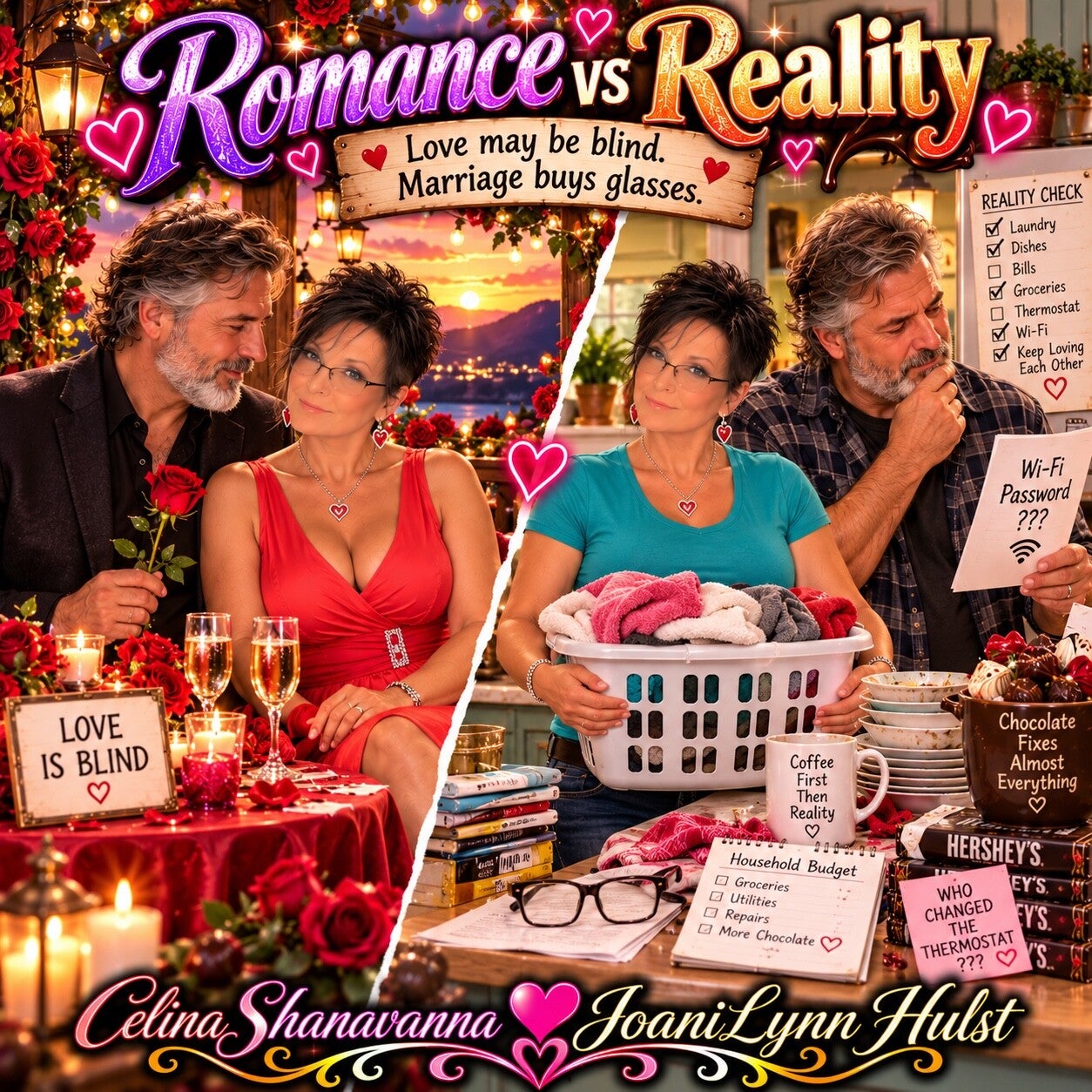
Romance vs Reality takes the familiar saying that love is blind and gives it a humorous twist: romance allows people to overlook imperfections, while marriage introduces them to every habit, quirk, responsibility, and disagreement they never noticed during courtship.
During the early stages of romance, everything appears magical.
Unusual habits seem adorable.
Differences feel exciting.
Flaws become charming personality traits.
And the future appears filled with candlelight, passion, and effortless happiness.
But once the wedding celebrations end, everyday reality begins.
There are dishes to wash.
Bills to pay.
Household responsibilities to divide.
Thermostat disagreements to settle.
And countless little habits that suddenly become impossible to ignore.
Yet beneath the humour is a meaningful observation.
Marriage does not necessarily destroy romance. It reveals whether the love beneath the romantic fantasy is strong enough to become a genuine partnership.
The song celebrates the comedy of discovering that the person someone married is not a flawless fairy-tale character, but a real human being.
And sometimes, that reality can lead to something more meaningful than the original fantasy.
The deeper meaning
At its heart, Romance vs Reality explores the difference between falling in love with an idealized version of someone and learning to love the complete person.
The song follows a recognizable progression.
First comes infatuation.
Then courtship.
Then marriage.
And finally, the discovery of everyday reality.
During infatuation, attraction can influence how people interpret one another's behaviour.
A habit that might otherwise seem irritating becomes endearing.
A personality difference feels intriguing.
And a potential incompatibility may be overlooked because everything else feels wonderful.
The narrator exaggerates these experiences for comedic effect.
But the underlying observation is recognizable.
Early romance often emphasizes what people love about one another, while long-term partnership reveals how they handle everything else.
The song does not suggest that early romantic feelings are necessarily dishonest.
Instead, it recognizes that infatuation can provide an incomplete picture.
Red flags disguised as party flags
One of the funniest and most revealing images involves red flags appearing festive rather than concerning.
This is a clever example of romantic sarcasm.
During the excitement of falling in love, people may interpret questionable behaviour more generously than they otherwise would.
They may overlook incompatibilities.
Excuse repeated lateness.
Or convince themselves that concerning patterns are simply unusual personality traits.
The song exaggerates this tendency by turning warning signs into decorations.
The humour comes from recognizing how easily attraction can transform someone's interpretation of behaviour.
There is also a meaningful distinction here.
Not every irritating habit is a red flag.
Clutter, different preferences, and harmless quirks are not the same as controlling, abusive, or dishonest behaviour.
The song uses exaggeration to illustrate how infatuation can blur judgment, but its deeper lesson is that genuine love benefits from clear-eyed awareness.
Courtship as a highlight reel
The comparison between courtship and a carefully edited highlight reel is especially effective.
A highlight reel displays the most appealing moments.
It leaves out the ordinary frustrations.
The tired evenings.
The disagreements.
And the less flattering details.
Early dating can sometimes operate similarly.
People may put extra effort into their appearance.
Plan enjoyable activities.
Be unusually accommodating.
And present their most charming qualities.
This does not necessarily mean they are deliberately pretending.
It simply means that dating and living together can reveal different aspects of someone's personality.
Courtship often shows how two people enjoy spending time together. Marriage reveals how they manage an entire life together.
That distinction provides much of the song's comedy.
When adorable habits stop being adorable
The narrator offers several amusing examples of behaviours that change meaning over time.
The way someone eats.
Their lateness.
Their clutter.
Their moods.
During early romance, these habits may appear charming or mysterious.
Later, they may become recurring sources of frustration.
The behaviour itself may not have changed.
What changes is the context.
A messy apartment may seem quirky during occasional visits.
A messy shared home can become frustrating when one person is repeatedly responsible for cleaning it.
Being late may seem spontaneous during dating.
But repeated lateness can become stressful when schedules and responsibilities are shared.
The song humorously reveals how everyday consequences can change the way people experience familiar habits.
This is one of its strongest observations about long-term relationships.
Marriage hands you reading glasses
The reading-glasses metaphor is central to the song's identity.
Romantic love is described as blind.
Marriage, however, provides corrective lenses.
Suddenly, everything becomes clearer.
The imperfections.
The habits.
The responsibilities.
And the differences that were previously overlooked.
The humour lies in the idea that marriage does not merely improve someone's vision.
It practically forces them to notice everything.
The glasses symbolize the transition from romantic idealization to realistic understanding.
This is also why the title works so well.
Romance represents the dream.
Reality represents the complete picture.
And marriage becomes the experience that brings both into focus.
The wedding is not the ending
One of the most insightful moments occurs when the song compares the wedding to the end of a movie.
In romantic films, the wedding often represents the happy ending.
The couple overcomes obstacles.
They exchange vows.
They celebrate.
And the story concludes.
But real life does not stop when the wedding ends.
In many ways, the shared journey is only beginning.
There are financial decisions.
Domestic responsibilities.
Family matters.
Unexpected challenges.
And ordinary routines.
The wedding may conclude the courtship story, but it begins an entirely different chapter of partnership.
This observation is humorous because it challenges the traditional fairy-tale structure.
The romantic credits roll.
But someone still has to clean the kitchen.
The fluorescent light of marriage
The image of marriage as bright fluorescent lighting is wonderfully sarcastic.
Candlelight is flattering.
It softens imperfections.
It creates atmosphere.
And it encourages romance.
Fluorescent lighting does the opposite.
It reveals everything.
Nothing is softened.
Nothing is hidden.
And every detail becomes visible.
The contrast between candlelight and fluorescent light represents the difference between romantic atmosphere and everyday reality.
The metaphor is funny because it turns marriage into an almost comically unromantic inspection.
But it also introduces a valuable lesson.
Seeing someone clearly is not necessarily a bad thing.
It allows love to become grounded in reality rather than illusion.
Romance versus household responsibilities
Some of the song's funniest moments involve the contrast between romantic promises and practical domestic life.
During courtship, couples may imagine cooking together.
Sharing laughter.
Working as a team.
And enjoying every moment of domestic life.
But marriage introduces questions about responsibility.
Who cooks?
Who cleans?
Who remembers what needs to be done?
And who ends up carrying most of the workload?
The humour exposes a genuine relationship issue: romantic intentions do not automatically create an equal partnership.
This is where the song becomes more than comedy.
It suggests that lasting love requires practical cooperation.
Affection matters.
But so do fairness, reliability, and shared effort.
The reality of compromise
Another clever contrast concerns compromise.
During early romance, people often promise that they will always meet each other halfway.
The idea sounds beautiful.
But real compromise requires actual decisions.
Who changes their plans?
Whose preference takes priority?
What happens when both people want different things?
And how do they resolve disagreements without resentment?
Compromise is easy to promise in theory and considerably more complicated to practice in everyday life.
The song captures this difference through humour.
Marriage becomes the place where vague romantic promises must turn into concrete behaviour.
The lesson is not that compromise is impossible.
It is that meaningful compromise requires communication, fairness, and effort from both people.
Poetry versus spreadsheets
One of the song's most entertaining contrasts is between romantic poetry and financial planning.
Romance is associated with music, dancing, rain, and beautiful moments.
Marriage introduces budgets, expenses, and practical decisions.
The contrast is deliberately exaggerated.
But it reflects the different responsibilities involved in sustaining a shared life.
Romance creates emotional excitement. Partnership requires people to manage reality together.
The song does not argue that one is more important than the other.
Rather, it shows that lasting relationships need both.
Love without practical cooperation can become strained.
Practical cooperation without affection can become emotionally empty.
A healthy partnership benefits from balancing the two.
From sunsets to paint colours
The comparison between romantic sunsets and choosing paint for a living room is another particularly clever image.
During courtship, couples admire beautiful things together.
They enjoy experiences without necessarily having to make practical decisions about them.
Marriage introduces choices that affect their shared environment.
Even something as ordinary as selecting a paint colour can reveal different preferences.
One person likes blue.
The other prefers beige.
One wants to renovate immediately.
The other would rather save money.
The comedy lies in discovering that sharing romantic dreams is sometimes easier than agreeing on everyday details.
Yet these small decisions are also part of building a life together.
They become opportunities to practice patience and cooperation.
Soulmates and Wi-Fi
The Wi-Fi reference brings the song into recognizable modern domestic life.
The contrast is wonderfully absurd.
One moment, two people are declaring themselves soulmates beneath the stars.
The next, they are trying to determine who is responsible for fixing the internet.
This shift captures the song's central comedic style.
It repeatedly places grand romantic ideals beside ordinary inconveniences.
The humour comes from the enormous difference between the language of romance and the practical details of living together.
Yet the two are not necessarily incompatible.
A couple can believe they share a meaningful emotional connection while also disagreeing about technology, household chores, and daily responsibilities.
The importance of accepting imperfections
As the song progresses, its tone becomes more reflective.
The narrator begins to acknowledge that marriage is not simply about discovering irritating habits.
It is also about learning to accept another person as a complete human being.
The person who seemed perfect during courtship turns out to have flaws.
But so does everyone.
The challenge is learning which differences are harmless, which require compromise, and which reveal genuine incompatibility.
Mature love is not necessarily about finding someone without imperfections. It is about seeing someone clearly and deciding whether a healthy, respectful partnership can be built together.
This is one of the song's strongest life lessons.
The disappearance of idealization does not have to mean the disappearance of affection.
Sometimes it allows affection to become more realistic.
Passion and patience
Another meaningful theme is the relationship between passion and patience.
Romantic attraction may bring people together.
But long-term partnership requires more than excitement.
It requires understanding.
Communication.
Compromise.
And the ability to navigate ordinary frustrations without allowing every disagreement to become a crisis.
Passion may begin a relationship, but patience helps sustain it.
The song uses humour to reveal how much everyday life can test that patience.
Blankets.
Coffee breath.
Household temperatures.
And small differences in habits become opportunities either for irritation or affectionate acceptance.
The meaning of marrying history
One of the most insightful observations is that marriage involves more than the mystery and excitement of a new romantic partner.
Each person brings a history.
Established habits.
Personal preferences.
Past experiences.
And ways of responding to stress.
These qualities do not disappear after the wedding.
Instead, they become part of the shared relationship.
Marriage brings together two complete individuals, not two flawless romantic characters created for a fairy tale.
This observation gives the song emotional maturity.
The narrator recognizes that a lasting partnership involves accepting the reality of who someone is, not merely the fantasy of who they appeared to be during courtship.
The deeper partnership beneath the humour
Although much of the song focuses on irritating habits and domestic disagreements, it does not portray marriage as entirely negative.
In fact, the later verses reveal a surprisingly affectionate perspective.
The narrator acknowledges the possibility of steady partnership.
Reliability.
Familiarity.
And a deeper understanding of one another.
The initial excitement may change.
But something more substantial can develop.
The song suggests that lasting love can become stronger when it moves beyond idealization and grows into genuine acceptance.
This is an important distinction.
The narrator is not simply mocking marriage.
She is celebrating its absurdities while recognizing its potential depth.
Why HUMOR & SARCASM is the primary category
The song's most distinctive feature is its comedic treatment of romantic expectations.
Its humour relies on exaggeration, irony, witty comparisons, and unexpected contrasts.
Romantic candlelight becomes fluorescent lighting.
Poetry becomes budgeting.
Soulmates become Wi-Fi troubleshooting.
And the fantasy of flawless love becomes an intimate knowledge of someone's least glamorous habits.
The song deliberately uses comedy to reveal truths about relationships that might otherwise be expressed through serious advice.
That makes HUMOR & SARCASM the strongest primary category.
LIFE LESSONS, WISDOM & PERSONAL GROWTH is an important secondary category because the lyrics contain meaningful observations about realistic expectations, compromise, and acceptance.
RELATIONSHIPS is also central because the entire song examines the transition from courtship to marriage.
The significance of the ending
The ending returns to the central metaphor of love being blind and marriage providing glasses.
But the meaning has evolved.
At the beginning, the glasses seem like an unwelcome surprise.
They expose irritating habits and destroy romantic illusions.
By the end, clearer vision becomes something valuable.
The narrator recognizes that seeing a partner realistically can create the foundation for a stronger relationship.
The glasses no longer symbolize the destruction of romance. They symbolize the possibility of loving someone with genuine understanding.
This is a particularly effective emotional progression.
The song begins by laughing at romantic blindness.
It explores the shock of domestic reality.
And it concludes by suggesting that clarity can lead to a more mature kind of love.
The central message
Ultimately, Romance vs Reality is about the hilarious but meaningful transformation that occurs when romantic infatuation meets the everyday realities of marriage.
The song reminds listeners that falling in love and building a life together are not exactly the same experience.
Courtship often emphasizes excitement.
Marriage introduces responsibility.
Romance celebrates someone's most appealing qualities.
Daily life reveals their habits, imperfections, and limitations.
But those discoveries do not necessarily mean love has failed.
They may simply mean that the relationship has moved beyond fantasy.
Perhaps the deepest message is this:
Real love is not about remaining blind to someone's imperfections. It is about seeing the complete person clearly and discovering whether affection, respect, patience, and partnership can survive the reality of everyday life.
The song recognizes that romance is beautiful.
That infatuation can be delightful.
And that the excitement of falling in love deserves to be enjoyed.
But it also recognizes that lasting relationships require more than beautiful promises.
They require communication.
Shared responsibility.
Humour.
Compromise.
And a willingness to accept the ordinary realities of being human.
Romance sees perfection.
Marriage discovers imperfections.
Romance dreams of forever.
Marriage discovers what forever actually involves.
Romance promises compromise.
Marriage asks who is washing the dishes.
Romance imagines a fairy tale.
Marriage introduces the thermostat, the laundry, and the Wi-Fi password.
And somewhere between the romantic fantasy and the everyday chaos, a deeper form of love may emerge.
One that is less dependent on idealization.
More grounded in reality.
And strengthened by the ability to laugh together through life's imperfections.
The song's final punchline captures everything with delightful simplicity:
Love may be blind, but marriage buys glasses.
And sometimes, seeing clearly is exactly what allows love to become something lasting.
Romance vs Reality is a humorous celebration of the difference between falling in love with a dream and learning to love a real person.